
Dry Needling
Written by: Dr. Natalie Kvas, PT, DPT
Why We Use Dry Needling
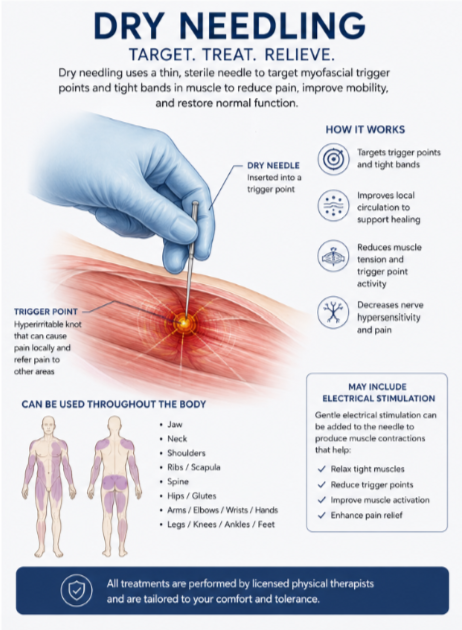
Dry needling is an evidence-based treatment used by our physical therapists to reduce pain, improve mobility, and restore normal muscle function. Using a thin, sterile needle, we target specific trigger points and areas of tissue dysfunction to help reduce muscle tension and improve movement.
Dry needling can help:
Reduce painful trigger points and muscle tightness
Increase local circulation to support the body's natural healing process
Decrease muscle guarding and improve tissue mobility
Reduce nerve hypersensitivity associated with persistent pain
Prepare muscles for exercise and rehabilitation
In some cases, we combine dry needling with electrical stimulation (e-stim). The gentle stimulation produces repeated muscle contractions that can help relax stubborn trigger points, improve muscle activation, and provide additional pain relief.
Dry needling can be performed throughout much of the body, including the jaw, neck, shoulders, ribs and shoulder blade, spine, hips, and both the upper and lower extremities. Every treatment is individualized and performed within each patient's comfort level.
What Does the Research Say?
Current research supports dry needling as an effective treatment for many musculoskeletal conditions, particularly when used alongside a comprehensive physical therapy program rather than as a stand-alone intervention.
A 2017 systematic review and meta-analysis published in the Journal of Orthopaedic & Sports Physical Therapy (JOSPT) concluded that dry needling performed by physical therapists is effective for reducing pain and improving pressure pain thresholds in the short term, with the strongest outcomes seen when combined with other physical therapy interventions.
An updated 2020 systematic review and meta-analysis of patients with neck pain found evidence that dry needling decreases pain and disability immediately after treatment.
Additional systematic reviews have demonstrated short-term reductions in pain for trigger points throughout the body, supporting dry needling as a valuable adjunct to exercise and manual therapy for treating myofascial pain.
At our clinic, dry needling isn't a stand-alone treatment—it's one of many evidence-based tools we use to help decrease pain, restore movement, and get you back to doing the activities you enjoy.
References
Gattie E, Cleland JA, Snodgrass S. The Effectiveness of Trigger Point Dry Needling for Musculoskeletal Conditions by Physical Therapists: A Systematic Review and Meta-analysis.Journal of Orthopaedic & Sports Physical Therapy. 2017;47(3):133-149.
Navarro-Santana MJ, et al. Effectiveness of Dry Needling for Myofascial Trigger Points Associated with Neck Pain Symptoms: An Updated Systematic Review and Meta-analysis.Journal of Clinical Medicine. 2020.
Kietrys DM, et al. Dry Needling in Subjects With Muscular Trigger Points in the Lower Quarter: A Systematic Review.International Journal of Sports Physical Therapy. 2015.